

4 Must know about self feeding
/Self feeding is an important development for children. Teaching children to self feeding may not be an easy thing. But feeding your child continuously until he grows up is not good either. This will only hinder its development.
Self feeding in children comes in phases, making it a long drawn out, but extremely rewarding, journey for you and your child. Although your child needs to reach toddlerhood to have the physical ability to self feed, it helps to start early. Here are the 4 must know things before you start letting your baby self feeding.
Content:

Self feeding advantages
Some parents choose to continue feeding their children because they don't want their children to be messy or dirty while eating alone. In fact, this is a learning process that children must go through. Baby led weaning (BLW) is a method that allows babies to self feeding. Mama only needs to prepare food that has been processed according to the baby's ability to eat, then the baby can use his hands to take and feed the food. Letting children eat alone also teaches him many things. Self feeding have many advantages.
Read more: Why letting your baby self-feeding is worth the mess
To prevent obesity
One of them is keeping children connected to their basic instincts (hunger) and listening to their own body cues (satiety). When a child is fed by another person, the child has the potential to eat more than they need, causing them to lose touch with their basic bodily instincts. In addition, it can also trigger stomach upset and can lead to eating problems later in life, such as obesity.
Helping children recognize the taste and texture of food
In applying the BLW method, food is served in a solid and larger form. This will allow your little one to recognize the texture because it is easy to grip. In addition, this method also introduces your little one to the various tastes, colors and aromas of the food he consumes.
Read more: Start feeding your kids solid food with this
Support children's motor development
Implementing the BLW method can support your little one's motor development, you know, Bun. This method can be a means for your little one to train eye and hand coordination, as well as chewing and grasping skills.
Read more: How to help my baby develop their pincer grasp?
Make children enjoy the food they eat
Teaching your little one this method allows him to enjoy the food he is eating without the need to be forced to open his mouth. In addition, your little one can also be introduced to many types of food.

How to encourage self feeding
Don't help put food in their mouth
You could say BLW is a method for making your little one independent when eating. You should really try to step back and believe that your baby can put food well in his mouth. Don't help put food in his mouth and you don't have to worry if you think he doesn't eat much. At this stage, food is a way for your little one to experiment and learn. As extra nutrition, your child will get what he needs from his milk, whether formula milk or breast milk.
Try offering a variety of foods
After your baby learns to use a spoon (holding objects between fingers and thumbs a.k.a. pincer grasp), you can introduce berries and raisins, or peas. Don't overwhelm your baby with too much food, having in front of him two or three items at a time is sufficient.
Read more: Baby's first solid food
Be patient
It is better if you don't rush when you want to let your children self feeding, because your child will choke on food if his age is not suitable, another reason is because he is not good at chewing food that is too solid. Wait until your baby is six months old and make sure he can sit up straight before starting self feeding. Be patient is the key.
Nothing comes easy with the baby. Every habit and every successful milestone is a result of someone’s effort. It could be you, your nanny, your spouse, the siblings or even strangers.
Read more: 3 Rules you must follow when giving first food to your children

Best self feeding age
Learning to self feeding can generally begin at the age of 9 months, when children are able to grasp their own food. At this age, parents is allowed to give them finger foods or foods that are easy to grasp. Children will become interested in holding their own spoon, fork, or water bottle in both hands when they are 13–15 months old.
In my daughter case, I let her start hold when she was 7 months. The food does not always fill the spoon and she not always succeeds in putting it in her mouth. Not a little food will also fall on the floor or table.
Around 18-24 months of age, they will begin to be adept at putting their own food into his mouth less messy. However, your little one must always be supervised when learning to eat on their own. Because they are still learning, sometimes children may choke, cough, or vomit. Later when your little one enters the age of 24–36 months, they will be more adept at eating and enjoying their own food without the need for help from adults.

My favorite self feeding spoon
You might be wondering if you can just get away with using a regular old steel spoon to feed your baby. After all, if it’s good enough for you to eat with, shouldn’t it be fine for a baby?
Some old-school parents will shrug and say that you can feed a toddler just fine without buying yet another special tool. But most feeding authorities recommend using a shallow, plastic children’s spoon for feeding, since it’s easier for them to eat from and won’t hurt their delicate mouths.
Read more: Baby essentials that is important for your children's development
Combined spoon and teether
Some spoons are made a little larger with a more chewy texture, for those teething kids who to bite down on as they eat. The teething element may encourage some kids to use the spoon.
Grabease stage 1 silicone spoon
The soft spoon is perfect for tiny mouths during the early stages of self-feeding, and the textured handle soothes little one's gums during teething. Kickstart BLW with Grabease stage 1 self-feeding silicone spoon.


Shaped ergonomic spoons
Little hands can be clumsy and a spoon is hard to hold. This style of spoon is usually chunkier and shaped to help toddlers get to grips with their fine motor skills.
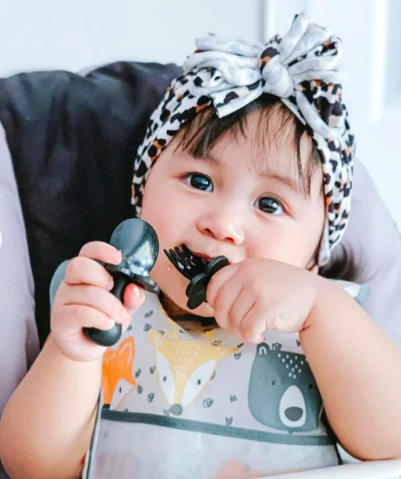
Grabease stage 2 spoon and fork
Grabease patented fork and spoon sets were the first utensils designed with babies’ independence in mind, and they come highly recommended by Occupational Therapists. The ergonomic handle fits comfortably in babies' natural hand grasp, making the hand-to-mouth motion easier. This set will also help strengthen their fingers while encouraging proper pencil grasp development (this will come in handy later!).
BONUS! Yummy and healthy ice cream for your baby with Grabease

